You signed up for web hosting at $3.95 a month. A year later, your credit card gets charged $155.88. You didn’t upgrade anything. You didn’t add anything. The only thing that changed is the price … because the price you signed up for was never really the price.
If this just happened to you, here’s the short version: you bought an introductory rate, and it expired. Your plan renewed at the standard rate, which is typically two to four times higher. This is standard practice across the hosting industry, it was almost certainly disclosed somewhere you didn’t look, and there’s a simple way to make sure it never surprises you again.

The two prices every hosting plan has
Nearly every budget hosting plan is sold with two prices:
- The introductory price. The big number on the homepage: $2.99/month, $3.95/month, sometimes $1 for the whole first year. This is a new-customer discount, and it applies only to your first term.
- The renewal price. What you’ll actually pay from the second term onward. This is the plan’s real price, and it’s usually printed in noticeably smaller text.
Why do companies do it this way? Acquiring a new customer is expensive: advertising, signup incentives, support for a brand-new account. The intro discount is the cost of winning your business, and the renewal price is where the company makes it back. It’s the same logic as a gym membership deal or a cable promo rate. The discount is genuine. It’s just temporary.
Here’s the part that stings: this is almost never hidden in any legal sense. The renewal rate is typically printed on the pricing page (in fine print near the big number), shown in the cart before checkout, or spelled out in the terms of service. Companies disclose it because they have to. Customers miss it because nobody reads the second number when the first one looks that good. If you call to complain, “it was on the pricing page” is the entire customer-service script, and it’s usually true.
Do the real math: what three years actually costs
The headline price is advertising. The number that matters is the true cost over the time you’ll actually use the plan. Here’s how to compute it with a realistic example.
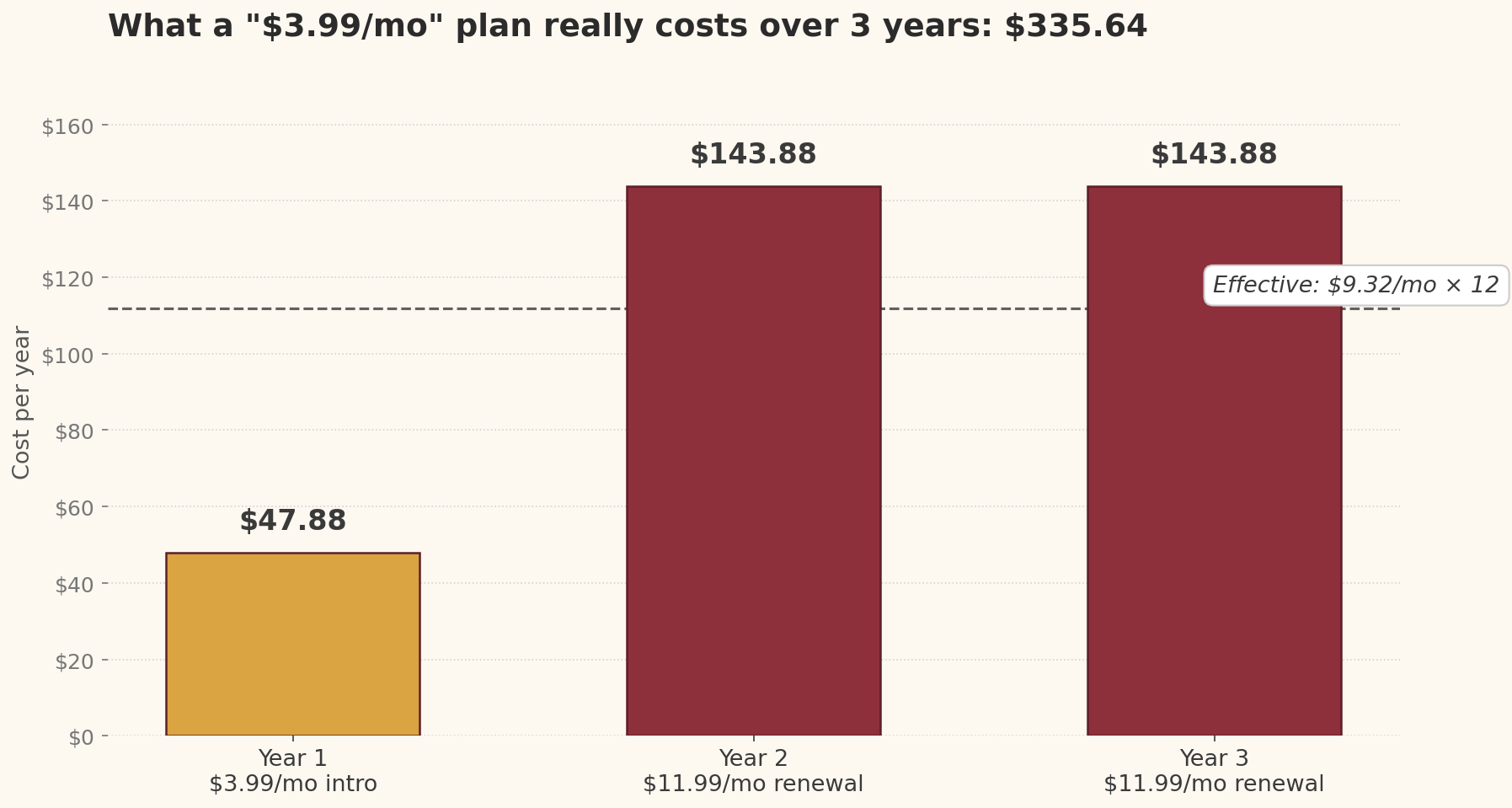
Say a plan is advertised at $3.99/month, and the fine print says it renews at $11.99/month:
- Year 1: $3.99 × 12 = $47.88
- Year 2: $11.99 × 12 = $143.88
- Year 3: $11.99 × 12 = $143.88
- Three-year total: $335.64, an effective rate of $9.32/month
That “$3.99/month” plan actually costs $9.32/month over three years, more than double the advertised price. And three years is the friendly scenario. Industry analyses of entry-level shared plans consistently find renewal multiples of 3x to 5x, with the cheapest headline prices carrying the steepest jumps. A $1/month first-year offer renewing at $14/month isn’t a glitch; it’s the business model working as designed.
The formula is simple enough to do on your phone before you buy:
(intro monthly rate × intro months) + (renewal monthly rate × remaining months), divided by total months.
That single number, your effective monthly cost, is the only honest basis for comparing two hosts. A plan advertised at $6.99/month with a $9.99 renewal is cheaper over three years than a plan advertised at $2.99/month with a $14.99 renewal, and it’s not close.
Watch the intro term length, not just the rate
There’s a second trap inside the first one: the advertised monthly price usually assumes you prepay for the longest available term, often two, three, or even four years upfront. Sign up month-to-month or for a single year and the “introductory” monthly rate can be much higher than the headline. Always check what commitment the advertised price requires, because a $2.99/month headline that demands three years prepaid is really a $108 decision, not a $3 one.

Where the renewal price hides: a pre-purchase checklist
Before you enter a credit card number anywhere, find the renewal rate. It’s in one of these places:
- The pricing page. Look directly under or beside the big price for phrases like “renews at,” “then,” or “regular price.” It’s there more often than people expect.
- The shopping cart. Many checkouts show the renewal rate per line item before you pay. Slow down at this screen. It’s the most honest page on the site.
- The terms of service. Search for “renewal” in the terms. Dry reading, but it’s the binding version of the price.
- The intro term length. Confirm how many months the intro rate covers and what you must prepay to get it.
- The add-ons. Domain privacy, daily backups, and business email are frequently free or bundled in year one and renew as separate paid line items. A $180 renewal invoice is often the base plan plus three add-ons you forgot were trials.
- Your calendar. Set a reminder 30 to 60 days before the term ends. This is the single most repeated piece of advice from people who’ve been burned, because it gives you time to renew deliberately, negotiate, or migrate instead of discovering the charge after the fact.
Domains play the same game
Hosting isn’t the only place this happens. Domain registrations routinely sell the first year cheap (sometimes a dollar or two), then renew at $20, $30, or more per year. Newer domain endings are the worst offenders: a bargain first-year registration can renew at ten or more times what you paid, turning a $2 impulse buy into a $30/year line item you can’t drop without abandoning your web address. The defense is identical: check the renewal price before you register, not the first-year price, and run the math over the years you’ll actually keep the name. A $2 first year renewing at $32/year costs $290 over a decade. The $2 headline contributed almost nothing. A domain is a ten-year relationship; price it like one.
The alternative: one price, every year
A smaller segment of the industry prices differently: the same rate for new purchases and renewals. No introductory discount, no renewal jump. The price on the page is the price in year one and the price in year five, which means you can budget it once and stop thinking about it.
That’s how we price at PageSmart, for example: a .com domain is $23.99/year whether you’re registering it new or renewing it. Same number, every year.
The honest tradeoff: flat pricing almost never wins the “cheapest first year” headline. If your only criterion is the lowest possible twelve months, an intro-discount plan will beat it. What you’re buying with flat pricing is the years after that: predictable costs, no calendar reminders, no renewal-day surprises, and no fine print to decode. For a business that plans to exist in three years, predictability usually beats a cheap first year.
The bottom line
Renewal shock isn’t a scam and it isn’t a mistake. It’s a pricing model, and once you see the two prices, you can shop with the real one. Find the renewal rate before you buy, run the three-year math, and decide with the effective monthly cost instead of the headline. Do that, and the invoice in year two will say exactly what you expected it to say.
If you’d rather skip the exercise entirely, that’s the idea behind how we price things at PageSmart: one rate, new or renewal, printed plainly. Come take a look when your current term is up, or better yet, about sixty days before.
Leave a Reply